Thursday, April 24, 2014
The History of Special Education in the United States
Prior to legislation requiring public education for children with
cognitive or emotional disabilities, deafness, blindness or the need for
speech therapy, among others, parents had few options other than to
educate their children at home or pay for expensive private education.
Education Department Loosens NCLB Waiver Requirements
States can now apply to renew their waivers for one year, instead of two.

Not long after it said states would have to increase their accountability measures to renew No Child Left Behind waivers, the Education Department is scaling back that process.
The department announced Aug. 29 that in order to renew the waivers that allow states to get around key requirements of the sweeping education law, they would have to show they are doing a better job of ensuring low-income and minority students are not disproportionately being taught by ineffective teachers, and that they would have to improve their use of federal funds for professional development.
Not long after it said states would have to increase their accountability measures to renew No Child Left Behind waivers, the Education Department is scaling back that process.
The department announced Aug. 29 that in order to renew the waivers that allow states to get around key requirements of the sweeping education law, they would have to show they are doing a better job of ensuring low-income and minority students are not disproportionately being taught by ineffective teachers, and that they would have to improve their use of federal funds for professional development.
Arne Duncan: School Expectations Are Too Low in the United States
Education leaders urged parents to become more involved and help close achievement gaps.

Today's parent advocates do not limit themselves to coaching soccer teams and organizing bake sales as a way to get involved in their students' schools. But parents, educators and policymakers alike need to do more to "walk the walk" in working to close achievement gaps and improve education in the United States, Secretary of Education Arne Duncan told an audience of parent leaders Monday.
While other countries have made strides in student performance on international tests in reading, math and science, American students have stagnated, and in some cases regressed, while achievement gaps in the country remain "staggeringly large," Duncan said at an education summit for parent leaders hosted by the National Assessment Governing Board.
Comparing American students to those in South Korea – a country that ranks among the highest in the world in terms of academic achievement – Duncan said part of the problem is a culture in the United States that perpetuates low expectations in schools. Parents in the United States do not demand the same kind of educational excellence as those in other countries, he said.
"As you think about how to use your voice, your time, and your energy, I want to pose one simple question to you: Does a child in South Korea deserve a better education than your child?" Duncan said. "If you answer is no – that no child in America deserves any less than a world-class education – then your work is cut out for you."
Part of the reason students in other countries outpace American students on these exams, Duncan said, is simply because they are more serious about education, not just in their cultures, but in their policies.
The former head of the Chicago public school system, Duncan told parents that there is a sense of complacency regarding education in the United States, but also a lack Duncan said, but also a lack of action by politicians.
"Both South Korean and U.S. citizens believe that the caliber of teacher matters tremendously, and the great teachers make a huge difference in children's lives," Duncan said. "The difference is: they act on their belief. We don't. We talk the talk, and they walk the walk."
While teachers in America often come from the bottom of the academic barrel and are disproportionately teaching students from disadvantaged backgrounds, Duncan said, teachers in South Korea are selected from the top of the class and are rewarded for working with low-income students.
Still, when people see statistics showing that by age 24, students from high income backgrounds earn bachelor's degrees at almost seven times the rate of those from low income families, they often blame poor academic achievement on the students' race, their family background or their cultures – not the school or school leaders, said Kati Haycock, president of The Education Trust.
"Our question back to them is if you're right, why are low income students and students of color performing so much higher in some schools?" Haycock said.
Haycock gave examples of schools across the country – such as Halle Hewetson Elementary in Las Vegas, George Hall Elementary in Mobile, Ala., and Elmont Memorial Junior-Senior High School in Elmont, N.Y. – with high numbers of minority and low-income students and histories of poor performance that were able to turn around due to changes in leadership, teachers, staff training and parent involvement.
Now, students in those schools are outperforming students throughout the state.
Not only does the quality of the teachers matter for low income and minority students to improve academically, said Charles Payne of the University of Chicago. Students from those backgrounds also benefit more from more rigorous standards, but are the least likely to gain access to them – and it's up to parents to work with schools to push for those higher expectations, he said.
But because people are often "skittish" about bringing up issues of race, Payne encouraged parents to "ask a lot of questions," about how race relates to education and work to build trust between parents, teachers and students.
"Schools that pride themselves on color blindness ... are living in a false world," said Payne, a professor in the university's School of Social Service Administration. "That is simply a lie. If you live in America, you see race."
Otha Thornton, president of the National PTA, said parents should take that next step to become more "connected, dedicated, and advocacy-minded" to drive change within American schools, rather than standing on the sidelines.
"Accountability for education begins at home. But unfortunately, not all children have an advocate at home," Thornton said. "Be committed to speak up and speak out, and sometimes show out, to ensure that no child falls through the cracks."
Wednesday, April 23, 2014
Medical Training Was Designed to Reduce the Number of Doctors

Photo by Thinkstock
We need more doctors. On a global
scale, the shortage is staggering: The World Health Organization says we
need 15 percent more doctors. In the United States, the American
Association of Medical Colleges estimates the current deficit at almost
60,000 and forecasts a worrisome 130,600-doctor shortfall by 2025.
There’s one simple solution: We have to consider ways to manufacture
doctors faster and cheaper.
An American physician spends an average of 14 years
training for the job: four years of college, four years of medical
school, and residencies and fellowships that last between three and
eight years. This medical education system wasn’t handed down to us by
God or Galen—it was the result of a reform movement that began in the late 19th
century and was largely finished more than 100 years ago. That was the
last time we seriously considered the structure of medical education in
the United States.
The circumstances were vastly different at that time. Until the Civil
War, private, for-profit medical schools with virtually no admissions
requirements subjected farm boys to two four-month sessions of lectures
and sent them off to treat the sick. (The second session was an exact
duplicate of the first.) The system produced too many doctors with not
enough training. Abraham Flexner, the education reformer who wrote an
influential report on medical education in 1910, put a fine point on the problem: “There has been an enormous over-production
of uneducated and ill trained medical practitioners,” he wrote.
(Emphasis added.) “Taking the United States as a whole, physicians are
four or five times as numerous in proportion to population as in older
countries like Germany.”
In other words, our current medical education system was originally
designed to reduce the total number of people entering the profession.
The academic medical schools that sprang up around the country—such as
the Johns Hopkins Hospital
in 1889—made college education a prerequisite. Medical school expanded
from eight months to three years and solidified at four years in the
1890s. Postgraduate training programs were implemented, beginning with a
one-year internship. These were brilliant reforms at the time.
Over the past century, there have been additions to, but few
subtractions from, the training process. Residency and fellowship
programs became longer and longer ... and longer. The path to some
specialties is now almost comically arduous. Many hand surgeons, for
example, complete five years in general surgery, followed by three years
in plastic surgery, followed by another year of specialized hand
surgery training. To be a competitive candidate for a hand surgery
fellowship, it’s also strongly recommended to spend two additional years
on research at some point during the process.
The current system has costs beyond making doctors expensive and
rare. The long process doesn’t just weed out the incompetent and the
lazy from the potential pool of physicians—it deters students who can’t
pay for so many years of education or who need to make money quickly to
support their families. That introduces a significant class bias into
the physician population, depriving a large proportion of the population
of doctors who understand their background, values, and challenges.
One solution is to simply lop off a few years from the process.
Writing in the Journal of the American Medical Association in 2012,
bioethicist Ezekiel Emanuel (one of those Emanuels) and economist Victor Fuchs recommended
shortening each stage by about 30 percent. Four years of premedical
training shouldn’t be a requirement for those who don’t want it or can’t
afford it, they argued. The fourth year of medical school is largely a
breeze, and a few progressive medical schools are now offering three-year programs to reflect that reality.
Accreditation of Postsecondary Education in the United States
Accreditation of Postsecondary Education in the United States
Prospective graduate students should have a basic understanding of accreditation and how it works

You may be wondering why it is important to know about
accreditation—simply put, not every institution is what it appears to
be. In order for you to become a smart consumer, you need to have a
basic understanding of accreditation in the United States and how it
works, the difference between accredited and unaccredited institutions,
and the pitfalls of enrolling in an unaccredited institution or
program.
Accreditation in the United States is a voluntary, nongovernmental
process, in which an institution and its programs are evaluated against
standards for measuring quality. The goal of accreditation is to ensure
that the education provided by institutions of higher education meets
acceptable levels of quality.
The Secretary of Education, through the U.S. Department of Education,
recognizes select accrediting agencies. Accreditation by a recognized
accrediting agency is one of the requirements for institutions to
participate in federal student aid programs. The Secretary and the
Department of Education are not responsible for accrediting individual
institutions. It is the responsibility of the accrediting agencies to
accredit colleges, universities, and programs.
An accrediting agency that meets the Department’s criteria for
recognition is determined to be a reliable authority in measuring the
quality of education or training provided by the institutions it
accredits in the United States and its territories. Agencies that meet
these criteria are placed on the Department’s List of Nationally
Recognized Accrediting Agencies.
Types of Accreditation
There are two basic types of educational accreditation. One is
identified as “institutional” and the other is referred to as
“specialized” or “programmatic.”
Institutional accreditation normally applies to an entire institution,
indicating that each of an institution’s parts is contributing to the
achievement of the institution’s objectives, although not necessarily
all at the same level of quality. The various commissions of the
regional accrediting associations, for example, perform institutional
accreditation, as do many national accrediting agencies.
Specialized or programmatic accreditation normally applies to programs,
departments, or schools that are parts of an institution. The
accredited unit may be as large as a college or school within a
university or as small as a curriculum within a discipline. Most of the
specialized or programmatic accrediting agencies review units within an
institution of higher education that is accredited by one of the
regional accrediting commissions. However, certain accrediting agencies
also accredit professional schools and other specialized or vocational
institutions of higher education that are free-standing in their
operations. In addition, a number of specialized accrediting agencies
accredit educational programs within non-educational settings, such as
hospitals.
Accredited Institutions
Accredited institutions have agreed to have their institution and its
programs reviewed to determine the quality of education and training
being provided. If an institution is accredited by a recognized agency,
its teachers, coursework, facilities, equipment, and supplies are
reviewed on a routine basis to ensure students receive a quality
education and get what they pay for. Attending an accredited institution
is often a requirement for employment and can be helpful later on if
you want to transfer academic credits to another institution.
Unaccredited Institutions
Unaccredited institutions are not reviewed against a set of standards
to determine the quality of their education and training. This does not
necessarily mean that an unaccredited institution is of poor quality,
but earning a degree from an unaccredited institution may create
problems for students. Some employers, institutions, and licensing
boards only recognize degrees earned from institutions accredited by an
accrediting agency recognized by the U.S. Department of Education. With
this in mind, it is recommended that students check with other
institutions regarding the transfer of credit policy to determine if
that institution would accept the degree and/or credits earned from any
institution they plan to enroll in.
A word of caution—in some states, it can be illegal to use a degree
from an institution that is not accredited by a nationally recognized
accrediting agency, unless approved by the state licensing agency.
The Positive List
The U.S. Department of Education has published the “positive list” of
schools that are accredited by accrediting agencies recognized by the
Secretary of Education. The list can be found at http://ope.ed.gov/accreditation.
This is a list of postsecondary institutions and programs that have
chosen to be accredited by accrediting agencies recognized by the U.S.
Secretary of Education. The database does not include postsecondary
educational institutions and programs that elect not to seek
accreditation but nevertheless may provide a quality postsecondary
education. The positive list is simply one source of information; you
may need to consult other sources if an institution does not appear on
the positive list.
Listed below are the major regional and national institutional accrediting agencies:
Middle States Association of Colleges and Schools
(DE, DC, MD, NJ, NY, PA, Puerto Rico, and the Virgin Islands)
(267) 284-5000
E-mail: info@msche.org
New England Association of Colleges and Schools
(CT, ME, MA, NH, RI, VT)
(781) 271-0022
E-mail: bbrittingham@neasc.org
North Central Association of Colleges and Schools
(AZ, AK, CO, IL, IN, IA, KS, MI, MN, MO, NE, NM, ND, OH, OK, SD, WV and WY)
(312) 263-0456
E-mail: info@hlcommission.org
Northwest Commission on Colleges and Schools
(AK, ID, MT, NV, OR, UT and WA)
(425) 558-4224
E-mail: selman@nwccu.org
Southern Association of Colleges and Schools
(AL, FL, GA, KY, LA, MS, NC, SC, TN, TX and VA)
(404) 679-4512
E-mail: bwheelan@sacscoc.org
Western Association of Schools and Colleges
(CA, HI and Guam.)
(510) 748-9001
E-mail: wascsr@wascsenior.org
The Distance Education and Training Council
(Accredits postsecondary institutions in the United States that offer
degree programs primarily by the distance education method up to and
including the professional doctoral degree.)
202-234-5100
E-mail: Detc@detc.org
Monday, April 14, 2014
U.S. students lag around average on international science, math and reading test
U.S. students lag around average on international science, math and reading test
 Scores in math, reading and science posted by 15-year-olds in the
United States were flat while their counterparts elsewhere —
particularly in Shanghai, Singapore and other Asian provinces or
countries — soared, according to the results of a well-regarded international exam released Tuesday.
Scores in math, reading and science posted by 15-year-olds in the
United States were flat while their counterparts elsewhere —
particularly in Shanghai, Singapore and other Asian provinces or
countries — soared, according to the results of a well-regarded international exam released Tuesday.
While U.S. teenagers were average in reading and science, their scores were below average in math, compared to 64 other countries and economies that participated in the 2012 Program for International Student Assessment, or PISA. That pattern has not changed much since the PISA test was first given in 2000.
“Our scores are stagnant. We’re not seeing any improvement for our 15-year-olds,” said Jack Buckley, commissioner at the National Center for Education Statistics, the research arm of the Education Department. “But our ranking is slipping because a lot of these other countries are improving.”
Education Secretary Arne Duncan called the scores a “brutal truth” that “must serve as a wake-up call” for the country.
The test scores offer fresh evidence for those who argue that the United States is losing ground to global competitors and others who say a decade’s worth of school reform has done little to improve educational outcomes.
“While the intentions may have been good, a decade of top-down, test-based schooling created by No Child Left Behind and Race to the Top — focused on hyper-testing students, sanctioning teachers and closing schools — has failed to improve the quality of American public education,” said Randi Weingarten, president of the American Federation of Teachers.
Some observers, including education historian Diane Ravitch, noted that American students have never been top performers on international tests dating back to the 1960s, but that has not prevented the country from becoming one of the most successful and innovative in the world. Ravitch accused Duncan of trying to “whip up a national hysteria”over the PISA scores.
Shanghai dominated the PISA exam, taking the top slot in all three subjects. The Chinese province catapulted to the top after focusing on teacher preparation and investing in its most challenging classrooms, among other things.
Germany, Poland and Italy were among several countries that made significant improvements in scores while Finland, which had been a top scorer in the past several exams, recorded a drop.
Overall, 40 of the 65 countries and economies made some progress, said Andreas Schleicher, deputy director for education and skills at the Organization for Economic Cooperation and Development. “In general, we’ve seen remarkable progress in education over the decade in the industrialized world,” he said.
China, the world’s most populous country and a fast-growing economy, did not participate in PISA, although several of its provinces did.
The test, administered every three years by the OECD, is designed to measure whether students can apply what they’ve learned in school to real-life problems. Approximately 510,000 15-year-olds in public and private schools took the paper-and-pencil exam in the fall of 2012.
On the math portion, 29 countries tested better than the United States. Aside from the Asia powerhouses of Shanghai, Singapore, Hong Kong, Taipei, Korea and Japan, the United States was outscored by European countries including Latvia, Britain, Poland, France, Germany and Slovenia.
In science, 22 countries posted better results than the United States, including Vietnam, Canada and Poland. In reading, 19 countries had higher scores than U.S. students, including Estonia and Liechtenstein.
Three states — Massachusetts, Connecticut and Florida — had students take the test to see how they compared internationally.
Students in Massachusetts and Connecticut scored above both the national and PISA average in math, while Florida scored below those averages. Massachusetts also beat the U.S. and OECD averages in science while Connecticut scored above the U.S. average and below the OECD average. Florida scored below both the U.S. average and OECD average in science. In reading, Massachusetts and Connecticut scored above the U.S. and OECD averages while Florida teenagers scored about the same as the U.S. and OECD average.
Not only did the United States score below average in math, it had fewer top performers. These are students who can develop “models for complex situations, and work strategically using broad, well- developed thinking and reasoning skills,” according to the OECD. While just 2 percent of U.S. teenagers reached that level in math, 31 percent of Shanghai students achieved it. The OECD average was 3 percent.
Even the top-performing U.S. state — Massachusetts — was outperformed by Shanghai. In math, 19 percent of Massachusetts students who took the exam placed in the top two levels of proficiency, while 55 percent of students in Shanghai reached those tiers. That difference is equivalent to more than two additional years of formal schooling, the OECD said.
At the other end of the spectrum, about 25 percent of U.S. students tested in the lowest levels of math proficiency — more than the OECD average. That statistic has not changed since 2003.
U.S. students are particularly weak in performing math tasks with higher cognitive demands, such as taking real-world situations and translating them into mathematical terms, according to the OECD report.
Despite their tepid math scores, U.S. teenagers were more confident about their math skills than their international counterparts, the report found.
Some observers say the United States does not perform well in international competitions because it is a large, diverse country, with the highest child poverty rate among industrialized countries.
But countries like Vietnam, where 79 percent of students are economically disadvantaged, outscored U.S. students in math.
“So it’s not demography itself. Those demographics are a factor, not the only factor,” Buckley said.
A weak curriculum could be the culprit, the report suggested.
“Perhaps the application problems that most students encounter today are the worst of all worlds: fake applications that strive to make the mathematics curriculum more palatable, yet do no justice either to modeling or to the pure mathematics involved,” the OECD said. Providing students with better opportunities to learn will help them develop skills to make frequent and productive use of math in their work and daily life, it said.
The new Common Core academic standards in math and reading, which have been fully adopted by 45 states and the District of Columbia, could help pull up the nation’s PISA scores, according to the OECD. While the standards are now being implemented in most U.S. classrooms, there has been growing political opposition from the right, left and center.
One clear finding from the PISA test was the impact of preschool education. Across countries, students who were enrolled in preschool consistently performed better on the test, Schleicher said.
Dennis Van Roekel, president of the National Education Association, said the country should end divisive debates about policies and adopt methods that are working in top-scoring nations. “We need to say we know what works, take it out of the political arena and do what’s right for kids,” he said.
Shocked by its moderate PISA results in 2000, Germany adopted national education standards and has taken steps to improve teacher education and establish a common test for final high school exams in all 16 German states. Germany’s 2012 PISA scores improved in math, reading and science.
The United States should also take several actions simultaneously, Duncan said. The country must “invest in early education, raise academic standards, make college affordable, and do more to recruit and retain top-notch educators,” he said.
Buckley cautioned against using the PISA results to draw conclusions about whether education policies are working.
“People like to take international results like this and focus on high performers and pick out areas of policy that support the policies that they support,” he said. “I never expect tests like these to tell us what works in education. That’s like taking a thermometer to explain why it’s cold outside.”
While U.S. teenagers were average in reading and science, their scores were below average in math, compared to 64 other countries and economies that participated in the 2012 Program for International Student Assessment, or PISA. That pattern has not changed much since the PISA test was first given in 2000.
“Our scores are stagnant. We’re not seeing any improvement for our 15-year-olds,” said Jack Buckley, commissioner at the National Center for Education Statistics, the research arm of the Education Department. “But our ranking is slipping because a lot of these other countries are improving.”
Education Secretary Arne Duncan called the scores a “brutal truth” that “must serve as a wake-up call” for the country.
The test scores offer fresh evidence for those who argue that the United States is losing ground to global competitors and others who say a decade’s worth of school reform has done little to improve educational outcomes.
“While the intentions may have been good, a decade of top-down, test-based schooling created by No Child Left Behind and Race to the Top — focused on hyper-testing students, sanctioning teachers and closing schools — has failed to improve the quality of American public education,” said Randi Weingarten, president of the American Federation of Teachers.
Some observers, including education historian Diane Ravitch, noted that American students have never been top performers on international tests dating back to the 1960s, but that has not prevented the country from becoming one of the most successful and innovative in the world. Ravitch accused Duncan of trying to “whip up a national hysteria”over the PISA scores.
Shanghai dominated the PISA exam, taking the top slot in all three subjects. The Chinese province catapulted to the top after focusing on teacher preparation and investing in its most challenging classrooms, among other things.
Germany, Poland and Italy were among several countries that made significant improvements in scores while Finland, which had been a top scorer in the past several exams, recorded a drop.
Overall, 40 of the 65 countries and economies made some progress, said Andreas Schleicher, deputy director for education and skills at the Organization for Economic Cooperation and Development. “In general, we’ve seen remarkable progress in education over the decade in the industrialized world,” he said.
China, the world’s most populous country and a fast-growing economy, did not participate in PISA, although several of its provinces did.
The test, administered every three years by the OECD, is designed to measure whether students can apply what they’ve learned in school to real-life problems. Approximately 510,000 15-year-olds in public and private schools took the paper-and-pencil exam in the fall of 2012.
On the math portion, 29 countries tested better than the United States. Aside from the Asia powerhouses of Shanghai, Singapore, Hong Kong, Taipei, Korea and Japan, the United States was outscored by European countries including Latvia, Britain, Poland, France, Germany and Slovenia.
In science, 22 countries posted better results than the United States, including Vietnam, Canada and Poland. In reading, 19 countries had higher scores than U.S. students, including Estonia and Liechtenstein.
Three states — Massachusetts, Connecticut and Florida — had students take the test to see how they compared internationally.
Students in Massachusetts and Connecticut scored above both the national and PISA average in math, while Florida scored below those averages. Massachusetts also beat the U.S. and OECD averages in science while Connecticut scored above the U.S. average and below the OECD average. Florida scored below both the U.S. average and OECD average in science. In reading, Massachusetts and Connecticut scored above the U.S. and OECD averages while Florida teenagers scored about the same as the U.S. and OECD average.
Not only did the United States score below average in math, it had fewer top performers. These are students who can develop “models for complex situations, and work strategically using broad, well- developed thinking and reasoning skills,” according to the OECD. While just 2 percent of U.S. teenagers reached that level in math, 31 percent of Shanghai students achieved it. The OECD average was 3 percent.
Even the top-performing U.S. state — Massachusetts — was outperformed by Shanghai. In math, 19 percent of Massachusetts students who took the exam placed in the top two levels of proficiency, while 55 percent of students in Shanghai reached those tiers. That difference is equivalent to more than two additional years of formal schooling, the OECD said.
At the other end of the spectrum, about 25 percent of U.S. students tested in the lowest levels of math proficiency — more than the OECD average. That statistic has not changed since 2003.
U.S. students are particularly weak in performing math tasks with higher cognitive demands, such as taking real-world situations and translating them into mathematical terms, according to the OECD report.
Despite their tepid math scores, U.S. teenagers were more confident about their math skills than their international counterparts, the report found.
Some observers say the United States does not perform well in international competitions because it is a large, diverse country, with the highest child poverty rate among industrialized countries.
But countries like Vietnam, where 79 percent of students are economically disadvantaged, outscored U.S. students in math.
“So it’s not demography itself. Those demographics are a factor, not the only factor,” Buckley said.
A weak curriculum could be the culprit, the report suggested.
“Perhaps the application problems that most students encounter today are the worst of all worlds: fake applications that strive to make the mathematics curriculum more palatable, yet do no justice either to modeling or to the pure mathematics involved,” the OECD said. Providing students with better opportunities to learn will help them develop skills to make frequent and productive use of math in their work and daily life, it said.
The new Common Core academic standards in math and reading, which have been fully adopted by 45 states and the District of Columbia, could help pull up the nation’s PISA scores, according to the OECD. While the standards are now being implemented in most U.S. classrooms, there has been growing political opposition from the right, left and center.
One clear finding from the PISA test was the impact of preschool education. Across countries, students who were enrolled in preschool consistently performed better on the test, Schleicher said.
Dennis Van Roekel, president of the National Education Association, said the country should end divisive debates about policies and adopt methods that are working in top-scoring nations. “We need to say we know what works, take it out of the political arena and do what’s right for kids,” he said.
Shocked by its moderate PISA results in 2000, Germany adopted national education standards and has taken steps to improve teacher education and establish a common test for final high school exams in all 16 German states. Germany’s 2012 PISA scores improved in math, reading and science.
The United States should also take several actions simultaneously, Duncan said. The country must “invest in early education, raise academic standards, make college affordable, and do more to recruit and retain top-notch educators,” he said.
Buckley cautioned against using the PISA results to draw conclusions about whether education policies are working.
“People like to take international results like this and focus on high performers and pick out areas of policy that support the policies that they support,” he said. “I never expect tests like these to tell us what works in education. That’s like taking a thermometer to explain why it’s cold outside.”
Primary Education in the US
Primary Education in the US
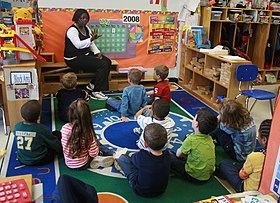
In the United States, children start their formal education around the age of six. (They may prepare for this beginning, the first grade, by attending a kindergarten program at age five or a nursery school program even earlier.) The first year at school is called kindergarten. It is required by all American children to be enrolled in the American education system. The second year at school is considered the first year of primary school and is referred to as first grade. Primary school most commonly consists of five years of education, referred to as first through fifth grades.At age five- six, American children begin elementary school by enrolling in the first grade, the first of twelve possible grades.
Academic Year
In United States school year runs from September to June, with a full summer vacation.
Enrollment of Children: Enrolling a child in an American public school is a fairly simple process. There are no interactions and interviews. The basic requirement for enrollment of a child in a public school is that you and your child live in the district. As a parent all you need to furnish is proof of residence with your name and address on it, like an apartment lease, though telephone and electric (utility bills) are widely preferred proofs. You will also be required to submit vaccination and other medical records.
In the United States, children start their formal education around the age of six. (They may prepare for this beginning, the first grade, by attending a kindergarten program at age five or a nursery school program even earlier.) The first year at school is called kindergarten. It is required by all American children to be enrolled in the American education system. The second year at school is considered the first year of primary school and is referred to as first grade. Primary school most commonly consists of five years of education, referred to as first through fifth grades.At age five- six, American children begin elementary school by enrolling in the first grade, the first of twelve possible grades.
Academic Year
In United States school year runs from September to June, with a full summer vacation.
Enrollment of Children: Enrolling a child in an American public school is a fairly simple process. There are no interactions and interviews. The basic requirement for enrollment of a child in a public school is that you and your child live in the district. As a parent all you need to furnish is proof of residence with your name and address on it, like an apartment lease, though telephone and electric (utility bills) are widely preferred proofs. You will also be required to submit vaccination and other medical records.
American Schools vs. the World: Expensive, Unequal, Bad at Math
American Schools vs. the World: Expensive, Unequal, Bad at Math
What the latest results of an international test tell us about the state of education in the United States

The U.S. education system is mediocre compared to the rest of the world, according to an international ranking of OECD countries.
More than half a million 15-year-olds around
the world took the Programme for International Student Assessment in
2012. The test, which is administered every three years and focuses
largely on math, but includes minor sections in science and reading, is
often used as a snapshot of the global state of education. The results,
published today, show the U.S. trailing behind educational powerhouses
like Korea and Finland.

Not
much has changed since 2000, when the U.S. scored along the OECD
average in every subject: This year, the U.S. scores below average in
math and ranks 17th among the 34 OECD countries. It scores close to the
OECD average in science and reading and ranks 21st in science and 17th
in reading.
Here are some other takeaways from the report:
America Is Struggling at Math
The U.S. scored below the PISA math mean and
ranks 26th out of the 34 OECD countries. The U.S. math score is not
statistically different than the following countries: Norway, Portugal,
Italy, Spain, Russian Federation, Slovak Republic, Lithuania, Sweden,
and Hungary.
On average, 13 percent of students
scored at the highest or second highest level on the PISA test, making
them “top performers.” Fifty-five percent of students in Shanghai-China
were considered top performers, while only nine percent of American
students were.
One in four U.S. students did not reach the
PISA baseline level 2 of mathematics proficiency. At this level,
“students begin to demonstrate the skills that will enable them to
participate effectively and productively in life,” according to the PISA
report.
Even the top students in the United States are behind: This year, the PISA report offered regional scores for Massachusetts, Connecticut, and Florida. Massachusetts, which is a high-achieving U.S. state and which averaged above the national PISA score, is still two years of formal schooling behind Shanghai.
America Spends a Lot of Money Per Student
The U.S. ranks fifth in spending per student. Only
Austria, Luxembourg, Norway, and Switzerland spend more per student. To
put this in context: the Slovak Republic, which scores similarly to the
U.S., spends $53,000 per student. The U.S. spends $115,000. The PISA
report notes that, among OECD countries, “higher expenditure on
education is not highly predictive of better mathematics scores in
PISA.”
Socio-Economic Class Plays a Larger Role in the U.S. Than in Other Countries
Fifteen percent of the American score variation
is explained by socio-economic differences between students. Less than
10 percent of score variation in Finland, Hong Kong, Japan, and Norway
is due to socio-economic differences.
The U.S. also has a lower than average number
of “resilient students,” which PISA defines as “students who are among
the 25 percent most socio-economically disadvantaged students but
perform much better than would be predicted by their socio-economic
class.” On average, seven percent of students are considered resilient.
Thirteen percent of of students in Korea, Hong Kong, Macao-China,
Shanghai-China, Singapore, and Vietnam are “resilient.”
The Countries That Are Doing Well
Parts of China, Singapore, Japan, Korea, and
Liechtenstein topped the rankings for math, reading, and science.
Finland, which is often pointed to as an example of an excellent school
system, continued to perform well. However, the country dropped 2.8
points in math, 1.7 points in reading, and three points in science in
“annualized changes in score points,” which are the “average annual
change in PISA score points since the country’s earliest participation
in PISA.”
The biggest annualized score improvements came
from Brazil, Tunisia, Mexico, Turkey, and Portugal. Italy, Poland, and
Germany also showed gains since 2003.
How seriously should we take these dismal findings? Educators around the world have called for tempered reactions to the PISA scores and questioned the usefulness of the tests.
Nevertheless, this year’s report—and the United States’ poor math
results—may be worth paying attention to for at least one reason. A 2011 study found that PISA scores are an economic indicator: rising scores are a good sign that a country’s economy will grow as well.
Understanding the American Education System
Understanding the American Education System
 The American education system offers a rich field of choices for
international students. There is such an array of schools, programs and
locations that the choices may overwhelm students, even those from the
U.S. As you begin your school search, it’s important to familiarize
yourself with the American education system. Understanding the system
will help you narrow your choices and develop your education plan.
The American education system offers a rich field of choices for
international students. There is such an array of schools, programs and
locations that the choices may overwhelm students, even those from the
U.S. As you begin your school search, it’s important to familiarize
yourself with the American education system. Understanding the system
will help you narrow your choices and develop your education plan.
The Educational Structure
Primary and Secondary School
Prior to higher education, American students attend primary and secondary school for a combined total of 12 years. These years are referred to as the first through twelfth grades.Around age six, U.S. children begin primary school, which is most commonly called “elementary school.” They attend five or six years and then go onto secondary school.
Secondary school consists of two programs: the first is “middle school” or “junior high school” and the second program is “high school.” A diploma or certificate is awarded upon graduation from high school. After graduating high school (12th grade), U.S. students may go on to college or university. College or university study is known as “higher education.”
Grading System

The grading system and GPA in the U.S. can be confusing, especially for international students. The interpretation of grades has a lot of variation. For example, two students who attended different schools both submit their transcripts to the same university. They both have 3.5 GPAs, but one student attended an average high school, while the other attended a prestigious school that was academically challenging. The university might interpret their GPAs differently because the two schools have dramatically different standards.
Therefore, there are some crucial things to keep in mind:
- You should find out the U.S. equivalent of the last level of education you completed in your home country.
- Pay close attention to the admission requirements of each university and college, as well as individual degree programs, which may have different requirements than the university.
- Regularly meet with an educational advisor or guidance counselor to make sure you are meeting the requirements.
Academic Year
The school calendar usually begins in August or September and continues through May or June. The majority of new students begin in autumn, so it is a good idea for international students to also begin their U.S. university studies at this time. There is a lot of excitement at the beginning of the school year and students form many great friendships during this time, as they are all adjusting to a new phase of academic life. Additionally, many courses are designed for students to take them in sequence, starting in autumn and continuing through the year.The academic year at many schools is composed of two terms called “semesters.” (Some schools use a three-term calendar known as the “trimester” system.) Still, others further divide the year into the quarter system of four terms, including an optional summer session. Basically, if you exclude the summer session, the academic year is either comprised of two semesters or three quarter terms.
The U.S. Higher Education System: Levels of Study
- First Level: Undergraduate
Your first two years of study you will generally be required to take a wide variety of classes in different subjects, commonly known as prerequisite courses: literature, science, the social sciences, the arts, history, and so forth. This is so you achieve a general knowledge, a foundation, of a variety of subjects prior to focusing on a specific field of study.
Many students choose to study at a community college in order to complete the first two years of prerequisite courses. They will earn an Associate of Arts (AA) transfer degree and then transfer to a four-year university or college.
A “major” is the specific field of study in which your degree is focused. For example, if someone’s major is journalism, they will earn a Bachelor of Arts in Journalism. You will be required to take a certain number of courses in this field in order to meet the degree requirements of your major. You must choose your major at the beginning of your third year of school.
A very unique characteristic of the American higher education system is that you can change your major multiple times if you choose. It is extremely common for American students to switch majors at some point in their undergraduate studies. Often, students discover a different field that they excel in or enjoy. The American education system is very flexible. Keep in mind though that switching majors may result in more courses, which means more time and money.
- Second Level: Graduate in Pursuit of a Master’s Degree
Furthermore, international students from some countries are only permitted to study abroad at a graduate level. You should inquire about the credentials needed to get a job in your country before you apply to a postgraduate university in the USA.
A graduate program is usually a division of a university or college. To gain admission, you will need to take the GRE (graduate record examination). Certain master’s programs require specific tests, such as the LSAT for law school, the GRE or GMAT for business school, and the MCAT for medical school.
Graduate programs in pursuit of a master’s degree typically take one to two years to complete. For example, the MBA (master of business administration) is an extremely popular degree program that takes about two years. Other master’s programs, such as journalism, only take one year.
The majority of a master’s program is spent in classroom study and a graduate student must prepare a long research paper called a “master’s thesis” or complete a “master’s project.”
- Third Level: Graduate in Pursuit of a Doctorate Degree
For the first two years of the program most doctoral candidates enroll in classes and seminars. At least another year is spent conducting firsthand research and writing a thesis or dissertation. This paper must contain views, designs, or research that have not been previously published.
A doctoral dissertation is a discussion and summary of the current scholarship on a given topic. Most U.S. universities awarding doctorates also require their candidates to have a reading knowledge of two foreign languages, to spend a required length of time “in residence,” to pass a qualifying examination that officially admits candidates to the PhD program, and to pass an oral examination on the same topic as the dissertation.

Characteristics of the U.S. Higher Education System
Classroom Environment Classes range from large lectures with several hundred students to smaller classes and seminars (discussion classes) with only a few students. The American university classroom atmosphere is very dynamic. You will be expected to share your opinion, argue your point, participate in class discussions and give presentations. International students find this one of the most surprising aspects of the American education system.Professors issue grades for each student enrolled in the course. Grades are usually based upon:
- Each professor will have a unique set of class participation requirements, but students are expected to participate in class discussions, especially in seminar classes. This is often a very important factor in determining a student’s grade.
- A midterm examination is usually given during class time.
- One or more research or term papers, or laboratory reports must be submitted for evaluation.
- Possible short exams or quizzes are given. Sometimes professors will give an unannounced “pop quiz.” This doesn’t count heavily toward the grade, but is intended to inspire students to keep up with their assignments and attendance.
- A final examination will be held after the final class meeting.
Credits Each course is worth a certain number of credits or credit hours. This number is roughly the same as the number of hours a student spends in class for that course each week. A course is typically worth three to five credits.
A full-time program at most schools is 12 or 15 credit hours (four or five courses per term) and a certain number of credits must be fulfilled in order to graduate. International students are expected to enroll in a full-time program during each term.
Transfers If a student enrolls at a new university before finishing a degree, generally most credits earned at the first school can be used to complete a degree at the new university. This means a student can transfer to another university and still graduate within a reasonable time.
Types of U.S. higher education
1. State College or University
A state school is supported and run by a state or local government. Each of the 50 U.S. states operates at least one state university and possibly several state colleges. Many of these public universities schools have the name of the state, or the actual word “State” in their names: for example, Washington State University and the University of Michigan.2. Private College or University
These schools are privately run as opposed to being run by a branch of the government. Tuition will usually be higher than state schools. Often, private U.S. universities and colleges are smaller in size than state schools.Religiously affiliated universities and colleges are private schools. Nearly all these schools welcome students of all religions and beliefs. Yet, there are a percentage of schools that prefer to admit students who hold similar religious beliefs as those in which the school was founded.
3. Community College
Community colleges are two-year colleges that award an associate’s degrees (transferable), as well as certifications. There are many types of associate degrees, but the most important distinguishing factor is whether or not the degree is transferable. Usually, there will be two primary degree tracks: one for academic transfer and the other prepares students to enter the workforce straightaway. University transfer degrees are generally associate of arts or associate of science. Not likely to be transferrable are the associate of applied science degrees and certificates of completion.Community college graduates most commonly transfer to four-year colleges or universities to complete their degree. Because they can transfer the credits they earned while attending community college, they can complete their bachelor’s degree program in two or more additional years. Many also offer ESL or intensive English language programs, which will prepare students for university-level courses.
If you do not plan to earn a higher degree than the associate’s, you should find out if an associate’s degree will qualify you for a job in your home country.